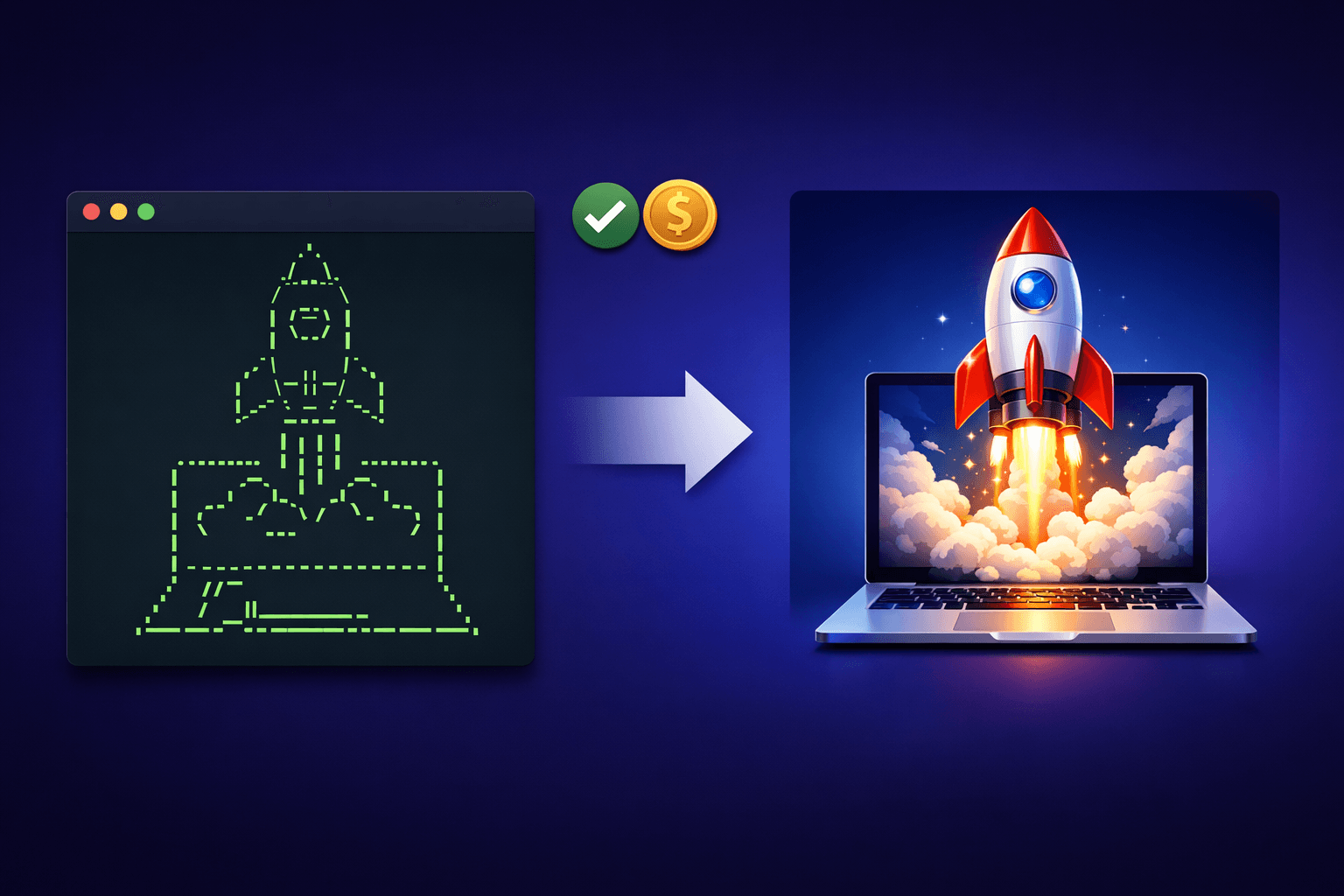
Build backend products, then ship a frontend. Agents are cracked at backend and limited at frontend.
Author: James Phoenix | Date: March 2026
The Core Insight
If you’re an indie startup choosing what to build, backend-heavy products are the default choice in the agent era. AI coding agents have fundamentally changed the economics of software development, but the gains are asymmetric: backend development gets 5-10x more leverage from agents than frontend development.
The strategic implication is simple: build the backend product first, ship a frontend later.
Why Agents Excel at Backend
Backend code is text in, text out. Every component can be statically analyzed, tested, and verified without leaving the code/text domain:
- APIs: Request in, response out. Fully testable via integration tests.
- Database operations: SQL queries, migrations, schema changes. All text.
- Business logic: Pure functions, state machines, validation rules. All verifiable in code.
- Infrastructure: Config files, deployment scripts, service orchestration. All text.
- Async workflows: Queue consumers, cron jobs, event handlers. All testable without rendering.
An agent can write a complete API endpoint, test it, verify the database interactions, and confirm correctness, all within its native medium of text. The feedback loop is tight: write code, run test, read output, iterate.
Why Agents Struggle at Frontend
The fundamental problem with frontend is that it is a pure composition of functions that can’t be statically analyzed in the code/text form. You need a renderer (Chrome, Safari, etc.) to evaluate whether the output is correct.
This creates a verification gap that breaks the agent loop:
| Backend | Frontend |
|---|---|
| Output is text (JSON, SQL, logs) | Output is pixels (layout, color, spacing) |
| Testable via assertions | Requires visual inspection or screenshot comparison |
| Deterministic verification | Subjective evaluation (“does this look right?”) |
| Errors are explicit (stack traces) | Errors are implicit (misaligned by 4px) |
| Agent reads test output directly | Agent needs browser rendering + screenshot analysis |
Even with browser automation tools (Playwright, Puppeteer), the agent is operating through an indirection layer. It writes JSX, then must render it, screenshot it, and interpret pixels to know if the result is correct. Every step in that chain introduces noise.
Specific Frontend Failure Modes
- Layout composition: Components render correctly in isolation but break when composed together
- Responsive behavior: Works at one viewport size, breaks at another
- Visual polish: Spacing, alignment, typography, color harmony. These are judgment calls, not logical assertions
- Interaction design: Hover states, transitions, scroll behavior. Require real-time evaluation
- Cross-browser quirks: CSS behaves differently across renderers
- State-dependent UI: Loading, error, empty, populated. Each state needs visual verification
The Strategic Playbook
1. Build Backend-First
Choose products where the core value is in the backend:
- Data pipelines and transformations
- API services and integrations
- Workflow automation (Temporal, queues, cron)
- AI/ML orchestration systems
- Developer tools and CLIs
- Monitoring and observability
Agents can build, test, and iterate on these at high speed with tight feedback loops.
2. Ship a Minimal Frontend Later
Once the backend works and delivers value, add a frontend. By this point:
- The API contracts are stable (agents wrote and tested them)
- The data models are proven
- You can use component libraries and templates to minimize custom UI work
- A human can handle the visual polish pass
3. Consider Frontend-Optional Products
Some products don’t need a frontend at all:
- API-as-product: Stripe, Twilio, SendGrid
- CLI tools: Developer utilities, automation scripts
- Backend-to-backend: Data processing, ETL, webhook handlers
- Agent-native products: Tools designed for other agents to use
These are the highest-leverage plays for agent-assisted indie development because the entire product lives in the domain where agents are strongest.
The Cloud Dev Environment Angle
This pattern is validated by real-world agent workflows. Consider a production setup where Claude Code Cloud runs end-to-end tests:
- Python deps install and API server starts automatically
- Database connects, seeds, and runs migrations
- Temporal workers spin up for async workflows
- Integration tests hit real external APIs through proxies
- Everything is prefixed with a feature slug for isolation
All of this is backend infrastructure. Agents handle it confidently because every piece is text-verifiable. The frontend? Explicitly excluded from the cloud environment because it requires visual verification that agents can’t reliably do.
When to Choose Frontend-Heavy Anyway
This is not absolute. Choose frontend-heavy if:
- The UI IS the product: Design tools, visual editors, creative software
- You have frontend expertise: Your edge is in visual/interaction design, not backend systems
- The market demands it: Consumer apps where UX is the moat
But if you have the choice, and you’re leveraging agents as your development force multiplier, backend-first is the higher-EV path.
The Bottom Line
Agents operate in the text domain. Backend is the text domain. Frontend is the pixel domain. The further your product lives from text, the less leverage you get from agents. For indie startups trying to maximize output with minimal human effort, this asymmetry is the single most important factor in choosing what to build.